
 cases
have been reported of people losing their limbs while on a picnic in the
desert
cases
have been reported of people losing their limbs while on a picnic in the
desert
teachers
unearthed a skeleton while they were digging in the yard

kuwait diary
Here's a recent article (December 18, 1999) which appeared in the Gulf News Tabloid section. It's interesting because it portrays some things I was visualizing during the war and aftermath, such as picnickers finding human bones. However, I didn't forsee the increase in criminal activity among Kuwaitis themselves...
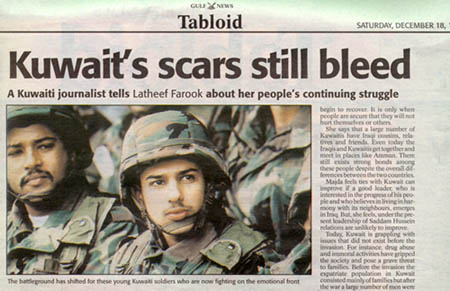
"Kuwait's scars still bleed" by Latheef Farook (Gulf News Tabloid, Dec.18,1999)
Kuwaiti journalist Majda Bader feels people in Kuwait are passing though
a critical social crisis following the Iraqi invasion of their country
in 1990. Despite the liberation, people in Kuwait are still unhappy and
there is little to smile about. Tempers soar at the slightest provocation
and youngsters take easily to violence to vent their sufferings and frustrations
following the war. There have even been incidents of students attacking
teachers while problems related to drugs, immoral activities and business
malpractices have become rampant.
Majda, a member of the Kuwaiti delegation to the
UN Women's Conference in Beijing, was recently in Bahrain to attend the
Advista Arabia conference. In an exclusive interview with Gulf News,
Majda talked about the devastating impact of the war on Kuwaiti society.
According to her, Kuwait has witnessed political, economic and social
upheavals.
She feels it is still a long way before complete
normalcy returns to Kuwait. On the political front, the parliament has
been restored and various issues are regularly addressed. And the country's
economy can improve only if there is a sense of overall security that
will bring in investments. But security seems like an impossible dream
with people still being haunted by the fear of war. The invasion not only
shattered buildings but destroyed people's peace of mind as well.
Any attempt to restore normalcy by the people,
by going to the desert, further compounds their misery as many areas are
littered with bombs. Often cases have been reported in the papers of people
losing their limbs while on a picnic in the desert. In fact people are
also reluctant to go swimming since many have found bombs floating in
the water.
"I myself have found many such bombs floating
in the sea," says Majda. This, she says, has led to people being
in a constant state of fear even when it comes to doing simple things
like taking a walk. At every step there is fear as people do not know
what to expect. Commercial centres and schools too have not been spared
and are not safe. A few weeks ago, it was reported that teachers had unearthed
a skeleton while they were digging in the yard to plant some samplings
in the garden.
Such incident have left deep scars on the minds
of people who feel helpless. People have become aggressive, bitter and
defensive. Psychologists feel a fear psychosis has gripped the people.
In their minds, they still fear war and believe it can happen again. The
past continues to haunt their present.
In fact, psychologists had warned of an increase
in the crime rate after the invasion which has turned out to be true.
The present period seems to be the peak of the crisis with a greater awareness
among Kuwaitis to address these psychological problems today.
According to Majda if Kuwaitis are reassured that
their neighbour no longer poses any threat, then only can the people feel
safe and begin to recover. It is only when people are secure that they
will not hurt themselves or others.
She says that a large number of Kuwaitis have
Iraqi cousins, relatives and friends. Even today the Iraqis and Kuwaitis
get together and meet in places like Amman. There still exists strong
bonds among these people despite the overall differences between the two
countries.
Majda feels ties with Kuwait can improve if a
good leader, who is interested in the progress of his people and who believes
in living in harmony with its neighbours, emerges in Iraq. But, she feels,
under the present leadership of Saddam Hussein relations are unlikely
to improve.
Today, Kuwait is grappling with issues that did
not exist before the invasion. For instance, drug abuse and immoral activities
have gripped the society and pose a grave threat to families. Before the
invasion the expatriate population in Kuwait consisted mainly of families
but after the war a large number of men were brought into the country
as cheap labour which has given rise to issues of adultery and drug abuse,
to the extent that children too have been reported to be party to this
misuse.
To fight this menace in society, an all out war
against drugs is underway in Kuwait with a number of groups, from religious
bodies to sports councils and women's associations reaching out to help
rehabilitate the victims. For Kuwait, it is still a long road to recovery.
By Latheef Farook
Reprinted without
permission (sorry)
Visit the Gulf News web site, an English language newspaper in the United Arab Emirates.
©janice
adams
back to war start
liberation day
kuwait
abu dhabi
travel
writing
family photo
album
home